Wednesday, 18 January 2012

Silent Encounters - Part 2

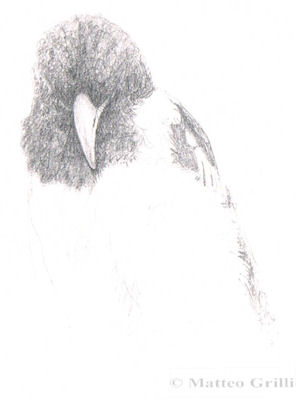
Watercolour on paper, 38x25cm, © Matteo Grilli 2012

The young one was restless, begging for food, but the parents were very quiet and still, the female was looking at me through the branches. Male and female have a slightly different colour, males tend to be grayish, females have a reddish or tawny shade on their feathers. Juveniles are something in between with darker  marks especially over the head.

 
Detail

It is surprising to see their agility and nocturnal activity comparing to their sleepy and quiet behaviour during the day. When threatened, they rely on their amazing camouflage, standing still and assuming an elongated posture to resemble a dead branch.
 
Work in progress

Tawny Frogmouths are very elusive an mysterious birds, hiding many secrets about their behaviour and biology. Professor Gisela Kaplan's book Tawny Frogmouth reveals many of this bird's secrets, it is the most comprehensive book about this 'Aussie icon' so far, gathering years of research revealing its very surprising hidden secrets. A truly recommended read.

Tools

At the end of these two paintings 'Silent Encounters' linked by the same story and experience, I was a bit surprised that 95% of the colours used is a mixture of just Burnt Umber and Neutral Tint, making it all appearing rather monochromatic.

Wednesday, 11 January 2012

Silent Encounters - Part 1

Watercolour on paper, 38x30 cm, life-size

It is difficult to spot Tawny Frogmouths. Walking through the park I noticed three Magpies on the ground, all three looking very inquisitive and curious towards another bird right between them. The bird was facing away from me so I could only see its back side, a big round head and a rounded body nearly invisible because of its amazing camouflage. Strange to see one on the ground in the daylight.

On my desk

Although Tawny Frogmouths - Podargus strigoides - are very similar to owls, they are not, they belong to the order of Caprimulgiformes and to the Frogmouth family, Podargidae. They are very skilled night hunters with big eyes and very soft feathers for a perfectly silent flight. The Magpies eventually lost interest and the bird (a female) then flew after a few minutes on a nearby tree where a nearly fully grown young was looking straight at me. On another branch there was what looked like the remains of an old nest, a flimsy pile of thin twigs,  half of it on the ground. I found some feathers.

Work in progress


When painting feathers there is often a feeling of being more a scientist than an artist, or something in between at least, like observing things through a microscope or a magnifying glass. Their feathers are covered with a layer of what appears to be fur, very very soft and this is the reason for their silent flight, just like owls.

Detail

To be continued next week...

Wednesday, 4 January 2012

Garden Visitors - the Pied Butcherbird


Every morning at dawn, in that time frame when all birds sing the most, in spring, I could hear this strange flute-like call from the Pied Butcherbird -Cracticus nigrogularis- the tune was perfect in pitch and time and slightly varied at times. It sounded very 'human' in the sense that I thought it was somebody whistling. I recorded it and transcribed it:


This bird may be considered the singer of the bush, with its huge repertoire of calls and songs of its own but also borrowed from other sources. For some reason they are aware that when a human is gardening there might be insects and worms around, so they come and perch very closely to the working gardener and carefully observe the surroundings until an insect runs away from the digging and pruning. The hunter then quickly flies down and grabs its meal.


Their calls and songs are made up of a wide range of mellow, sweet, mysterious and sad whistles and it is one of the most characteristic sound of the bush and suburban gardens. The pair living around our garden regularly comes for drinking and bathing in the bird bath just in front of my studio window. To watch and listen to them is a big pleasure. Once, just during one of its visit, it flew straight from the bird bath to the wall of the building behind it, flying away in less than a second with a gecko in its beak. Very skilled hunter, no wonder we now have a big curious young discovering the world after its parents.

Monday, 19 December 2011

On Life-changing Books - part two -


I found this French book of the American bird artist Louis Agassiz Fuertes in a second-hand book stall at the summer Sunday street market in my hometown Porto Recanati. I was a teenager and at that time I had no idea about who this artist was, but I was into watercolours and birds and the book was a good bargain and I could read French. I was surprised to read that he was self-taught and also stricken to see the level of detail and yet expression and movement.

Red-breasted Merganser ©Louis Agassiz Fuertes

At 22, self-taught, Fuertes (1874-1927) was considered the most talented American bird artist of the time. An intimate knowledge of his subjects' lives and behaviours allowed him to truthfully represent birds expressions and attitudes combined with an exact ornithological rendering.
He took part as an artist and illustrator in ornithological expeditions and scientific explorations over USA, Greater Antilles, Mexico, Colombia, and Ethiopia. Definitely an inspiring life.

Killdeer ©Louis Agassiz Fuertes

He used to work from life, patiently and rigorously observing the living bird relying on his prodigious visual memory to flawlessly capture expressions and attitudes, he also worked from dead specimens to take life-size measurements and other details both drawn and written very thoroughly.
I found a beautiful website-archive with many of his paintings and sketches which is really worth a visit, click here, I hope you'll enjoy.

Common Potoo ©Louis Agassiz Fuertes

And this is also the last post for this year, with many more on the way about my latest endeavours, I would like to wish all the readers and followers, regardless of what religion you may follow, if any,  a good time spent with loved ones, and best hopes for the new year to come.
Take care                                     Matteo

Monday, 12 December 2011

On Life-changing Books - part one -


When I was a kid, my mother, knowing about my passion for drawing and nature, got me a book which I regard now as one of those few that propelled me into seeing things in a different way. The book is called 'La natura e' meravigliosa' or 'Nature is Wonderful' in English, but the original Dutch title is 'Een zucht van verwondering', published in 1990. A huge collection of watercolour paintings and drawings, detailed yet as simple and humble as nature can be in her smallest forms: nests, insects, leaves, animals and birds, which all together narrated the events of nature, the changing tides, the migration of birds, the change of season, life between the dunes of sand by the northern seas, and then into the woods and the countryside of the Netherlands. Everything was narrated by a crystal clear text explaining the ways of nature and the interaction with man. I was stricken by the simple beauty of bare pencil and watercolour.

© Marjolein Bastin

After this book I decided I would have become a watercolourist. Marjolein Bastin (1943), the artist behind it, is Dutch, and clearly shows how the closer we look the more we see. Her strong bond with every living being, no matter how small and ordinary, has always been part of her life and has motivated her to start drawing and sharing her discoveries to the world. Worldwide renowned for her illustrations and licensing products, Marjolein Bastin has never stopped looking at things with the curious eyes of a child, capturing the hidden and overlooked beauties of nature, just as she sees them, imperfect, yet beautiful, small, yet no less important.

© Marjolein Bastin

Nature artist, writer, children's author and illustrator, Marjolein Bastin divides her time drawing inspiration from the nature of her homeland, the Netherlands, Missouri, Cayman Island and Switzerland.
Her books are among my most treasured ones, still reminding me to look at things closer to find something more and new and to change my point of view to find a new perspective.
© Marjolein Bastin

Monday, 5 December 2011

Avian Faces - Bush-stone Curlews


With this painting I wanted to focus on the variety of different expressions that I could notice in the Bush-stone Curlew, Burhinus grallarius. The bottom right bird looks 'sad' but I wouldn't say the bird was actually sad, the way they are able to move their feathers, especially around their eyes and beak, allows them to appear different according to their mood or need to communicate with other birds. I noticed this is even truer for nocturnal birds, probably due to the bigger size of their eyes. It is amazing and surprising how quickly and suddenly birds can change their appearance.

Detail

Monday, 28 November 2011

Brisbane Veranda


Queensland houses or 'Queenslander' have some architectural features which are just perfect for birdwatching: timber stumps that lift the building to provide ventilation during the hot summer months (let alone relative safety from floods) also provide for a high point of view to observe the surroundings from the front verandas and if trees are close enough you may have the impression of living right up in the tree canopy. Birds feel more comfortable to come and perch or feed on the wide verandas, giving excellent observation opportunities. These are some Sulphur-crested Cockatoo that usually come to our place.


Monday, 21 November 2011

Crimson Rosellas at the Lamington NP


The Lamington National Park is approximately 100 km south of Brisbane, declared in 1915 after Lord Lamington, the Governor of Queensland at that time. Remarkable for its 20500 ha, unique flora and fauna and the sheer beauty of its mountains and sub-tropical rain forests, the park was listed as a World Heritage Area in 1994.
 Walking in such an ancient forest encountering so many species of unique wildlife and massive trees was an amazing experience. Many of the encounters such as with the Albert's Lyrebird were fleeting, but Crimson Rosellas -Platycercus elegans- were very friendly and used to feed from people's hands.

View from the tree top

Rain forest waterfalls

View from inside a Strangler Fig

Monday, 14 November 2011

Fascinating feathers


From left: Barn Owl, primary; Laughing Kookaburra, primary; Masked Lapwing, tail feather; Figbird, secondary, Laughing Kookaburra, tail feather; Bush-stone Curlew, primary.
Primary feathers: outer feathers of the wing, provide thrust and propel the bird upward and forward;
Secondary feathers: provide lift by creating the airfoil shape of the bird's wing;
Tail feathers: help the bird to brake and steer in flight.
I've been collecting birds' feathers since I was a child, when our neighbours gave us the tail feathers of the Pheasant they killed and cooked. I still think I can give feathers a second chance to be admired, weather they come from a dead bird or are naturally shed when moulting. And I still wonder how far have they travelled, what places and the secret things they lived with their owner.
Here is a selection of artworks on feathers from my shop.


Monday, 7 November 2011

Playful Magpies


I was surprised to observe the behaviour of this family of Australian Magpies, Gymnorhina tibicen. The young one, in the middle with a stick, was playing around with it and the parents , darker in colour, were jumping all around him/her and lying down making strange moves. All three birds seemed to be very interested in the stick. Their behaviour reminded me of dogs playing with each other with a stick... funny Magpies..

Related Posts Plugin for WordPress, Blogger...