Saturday, 25 August 2012

City Life - the Australian White Ibis


The breeding season for the Australian White Ibis, Threskiornis molucca, has started here in Brisbane. Couples are building nests with twigs and small branches, usually not far from water and high on trees like Mangroves, Palms and also thick Bamboo. Some may probably already have eggs or young hatchlings.


Once the jouveniles leave the nest, they are very easily distinguished from the audults, they have a shorter bill and a dark feathery head compared to the bald head and neck of audults. The new generations also have a much whiter colour compared to the 'dirty' white of their parents. 


They have a very strong prehistoric look with their bald, wrinkly and scaly skin of head and neck. During the breeding season some magenta-carmine scales of skin appear at the back of audults' heads, as well as along the legs, their blue-black ornamental tertiary feathers become wider and shinier. They also seem to become more vocal and territorial or competitive, honking at each other very loudly.


They are opportunistic birds and they've adapted very very well to urban and suburban conditions, it looks like they are more common than crows and pigeons in Brisbane, invasive and shameless they often jump on cafe tables and walk among pedestrians across Queen Street Mall. Not very loved by people... but in the end they're just making the best out of what's available, aren't we doing just the same?

An older ink sketch

Wednesday, 15 August 2012

Kookaburra Couple


Greeting Cards available

I was captured by the unassuming colours of this bird contrasting so greatly with their strong personality. The explosive 'laughter' of the Laughing Kookaburras Dacelo novaeguineae, can be heard mostly before the sunrise, when it's still dark and after the sunset, just before complete darkness. It is a territorial signal. According to the Aboriginal belief, the Kookaburra's laughter every morning is a signal to the sky people to light the great fire that illuminates and warms the earth. The name 'kookaburra' apparently comes from an Aboriginal language that is now extint, the Wiradhuri from New South Wales.


Males and females are almost identical, I've been told males have blue feathers on the rump or upper-tail covert feathers. They can be very friendly especially when people feed them, but I red on the magazine called Australian Wildlife Secrets that it is not recommended to feed meat to wild birds as meat for human consumption is too rich in fat and protein for wildlife.


They hunt from the branches or from a favourite perch from which they observe the surroundings until a prey moves close. I once saw a male offering a small snake to the female, but she was not interested... According to the scientific classification, the Kookaburra belongs to the family of the King Fishers Halcyonidae but instead of living by the water, they evolved to be able to live in the drier conditions of the the bush and woodlands of Australia. 


Short update from my shop: international free postage now available for all Original Artworks

Until next time
All the best
M


Friday, 3 August 2012

Prints now available!

The Shop

I am very very glad to release this information as I just opened my Etzy shop, you will be able to find a selection of reproductions of some of my latest watercolour paintings in three sizes, small, medium and large and I also made a selection of older original artworks dating back from 2006 including before-Australia works that I'm willing to sell. I will be shipping all over the world.


Choice of 8 reproductions

Browsing the shop you'll find all the needed informations, if you don't, please just send me an email. This is all very exciting and I am absolutely thrilled to read your suggestions and feed backs, so please, do not be shy about leaving a comment.


Choice of 31 original artworks
I'm feeling thankful and blessed for all the support I received from both close and far away people as without it, all this now wouldn't be possible.

All the best
MG

Monday, 23 July 2012

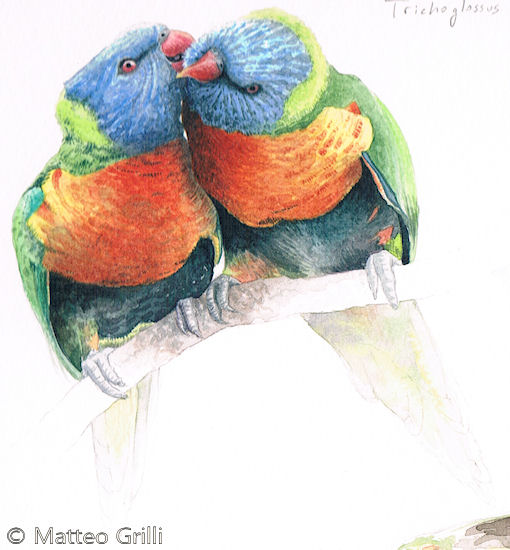
Garden Visitors - the Rainbow Lorikeets


A flock of Rainbow Lorikeets darting and calling each other in the sky. You can't get more Australian than this. I was noticing how nature manages to get some kind of balance, for instance, such a colorful and flamboyant bird is often appreciated for its look but certainly not for its calls, rather harsh and unpleasant for us, even though they sometimes produce some kind of mellow sounding whistles. If we think of all the avian species famous for their songs, they seem to never show a bright colorful plumage, they are in fact rather dull or humble in terms of colours. Feel free to bring some examples if you know otherwise!


As all other parrots they seem to tie very close bonds within the members of a couple.


And yet their colours are not just pretty, they end up being very useful to communicate within the flock and to deceive predators. Predators looking from the sky would find it hard to focus on a single bird looking just as the tree canopy on which it feeds, while other members of the flock will never loose eye contact with one another, thus helping each other as all flock birds do.

Shop update: the opening of my online shop has been delayed for a little bit longer, I was probably too optimistic, I just want to make sure everything is just right, this week I'm going to see some print samples and hopefully by the end of this week or the next at the longest I'll be ready for the opening. Exciting times!

All the best
M

Thursday, 5 July 2012

Avian Faces Series, #3 - the Boobook Owl


I'm glad I was able to gather enough material to work on another Avian Faces Series painting dedicated to an owl, the Boobook Owl, Ninox Novaeseelandiae. I see owls' faces as some of the most expressive in the avian world and the four represented here are only a few among the wide subtle range I could see.


In this post, I would also like to share the interview that Jenica Smith released on her website.


Also, for those who are interested in buying prints, at last, after the originals I sold, I have selected 8 paintings which are now being scanned and will soon become prints. I'm planning to open my Etzy shop within next week, finger crossed!

All the best
M

Wednesday, 20 June 2012

Garden Visitors - the Pied Currawong


The Latin name of this bird, Strepera graculina, means 'noisy jackdaw', and the common name Currawong is Aboriginal and is derived from the very musical and loud calls produced by it. Currawongs are the curious and inquisitive 'pirates' of the bush, harassing other species and members of their own group as well, but nature is rather even and the Pied Currawong is the favourite target for the Channel-billed Cuckoo, who, as other cuckoo species parasites other birds' nests.


The Artamidae family, which includes Butcherbirds, Magpies and Currawongs is rather talented, all members are in fact able to produce pleasing if not very nice and elaborate sounds. The Currawong's call is a loud, flute-like sound that echoes far and is a very typical sound of the bush.


Original paintings ready to be packed and delivered.

Business Cards!

Friday, 1 June 2012

Suburban Owls


I was invited for lunch at some friends' place in a northern Brisbane suburb and there I was surprised once again to see how wildlife is living just on the door-step of people's homes. Many times flamboyant, colourful, noisy and extravagant, other times quiet, secretive and unassuming. The Southern Boobook Owl, Ninox novaeseelandiae, was roosting sheltered on a lower palm leaf, scarcely about two meters from the ground, just on the side of the entrance driveway, silently sleeping and watching at times the comings and goings of both resident people and cars.


He or she didn't appear to be shy or scared, but allowed people to watch him from a very close distance, slowly closing and opening one eye-lid while keeping the other open and vigilant. Once again I found the owl's facial expressions very interesting and charming, softly moving and changing. Boobook Owls are very widespread all over Australia and their night call, a loud and repeated 'book-book' is perhaps one of the best known nocturnal sounds, you can hear a couple of samples here.
Good luck on you Mr. Hoot!


Work in progress

Tuesday, 15 May 2012

Shop coming soon...

Garden Visitors: Dainty Swallowtail, Papilio anactus above and Orchard Swallowtail, Papilio aegeus, the latter shows the difference between the male pattern on the left and the female on the right.

I am very glad to inform all the faithful readers and followers that I am working to produce high quality prints of my artwork to sell. I would like to thank all the people who have already contacted me asking for details about their favourite artworks, for their patience and awesome support.

I'd love to keep hearing from you, so if you have any enquiry, even just to let me know about your favourite artwork and your country, please don't hesitate to contact me via email, FaceBook, comments following the posts and subscribe to the newsletter, so that I can keep working on putting things together.

Every artwork on this blog can become a print for you to take home.

Watch this space!

MG


The Caterpillar of an Orchard Swallowtail is a noisy chewer, on the early stages the larva resembles a bird dropping, it later changes into a camouflaged green. Who could ever tell that from a bird-dropping-looking tiny creature an amazing butterfly will later develop?

Tuesday, 1 May 2012

Feather, Beetle and Skull: painting blacks without black

From left: feather of a Tawny Frogmouth, Podargus strigoides; Rhinoceros Beetle, Xylotrupes ulysses; skull of a Pied Butcherbird, Cracticus nigrogularis.


This small painting is a technical exploration on how to reach the darkest darks without using any black-containing pigment - no black, neutral tint, Payne's grey, seppia or indigo. A bit daunting considering that neutrals have always been my favourite and most used colours from the beginning. Yet I can now say that chromatic greys offer a neverending, moody, subtle and beautiful alternative to the black pigments. Colours used: Perylene Maroon, Phthalo Green, Prussian Blue, Burnt Umber, Yellow Ochre, Ultramarine Blue, Titanium (opaque) White for the very last few details on the beetle.


Sunday, 15 April 2012

Garden Visitors - the Crested Pigeon

 
Journal #8, page 4, Crested Pigeon, Ocyphaps lophotes
The whole eye appears to be bigger than it really is, thanks to a patch of bare red skin. This gives the bird a cartoon-like look and a range of interesting expressions.

Tertial left wing feather.

Related Posts Plugin for WordPress, Blogger...