Showing posts with label Feathers. Show all posts

Thursday, 15 August 2013

The Waterhouse Natural Science Art Prize

Feathers of Australian Birds


This original artwork was selected among the finalists for the Waterhouse Natural Science Art Prize. The exhibition of finalists' artworks is now on display at the South Australian Museum until 8 September 2013. Follow this link to see winners and finalists' works. All original artworks are for sale. And if you really want to buy this image but can't afford the original, there are prints and greeting cards now available.

Work in progress
The framed artwork just before being packed and shipped to Adelaide.

Friday, 15 March 2013

Meeting the Peewee


The Magpie-lark (Grallina cyanoleuca) is a very common suburban bird in Brisbane, it is often seen searching for food walking frantically across lawns, in pairs most of the times, if one is around usually the other is not far. I had the chance to study a breeding pair for a while and I was able to notice some very interesting things.


Male and female pair for life, different sexes have different colour patterns, females (above) have white forehead and throat, while males (below) have white eyebrows, black forehead and throat. Jouveniles have a mixed pattern with white throat and large white eyebrows, dark eyes and beak, audults have very light eyes and beak.


Both parents are very protective and won't hesitate to attack much larger birds which may be a threat for the nest such as crows. The nest is built with mud, grass and leaves. Male and female exchange nest duties approximately every 15 minutes, they both search for food so the babies can enjoy a constant food supply.


As the day gets hotter the parent stops sitting on the baby birds and stands over them with wings half open to provide shade to the nestlings.


Magpie-larks, also known as Peewees, are known to sing in duet to defend their territory. Each partner produces about one note a second but a half-second apart, so to the human ear it sounds coming from the same bird.


This beautiful bird has a very charming black and white plumage, which seems to be rather in fashion for Australian birds, their flying style reminds me of that of some bigger species of butterflies.
I hope you enjoyed reading about the Magpie-lark, until next time,

Matteo

Friday, 15 February 2013

Capturing the Iridescence


Iridescence is a very fascinating feature of feathers in many species of birds from all over the world. Certainly the brightest and most varied examples come from the birds of paradise, yet this kind of feathers are also found in birds that live in a much closer contact with humans, like ducks and chickens.


The former owner of this pair of iridescent feathers was a Pacific Black Duck, Anas superciliosa, one of the most common species of ducks, it is found along every creek and in every park around Brisbane. These two feathers are part of the secondary remiges group, one from each wing and in ducks this group of feathers is called speculum. Each species of duck has a slightly different colour, according to the angle from which we look, we can see a large number of colours, from dull green, grey and brown to a bright emerald green, purple, cyan blue, dark blue, magenta and a warm yellow-green.


Feather iridescence is the right subject to use Phthalo Blue and Phthalo Green with little or no mixing.
Representing feathers' iridescence with watercolours is challanging, one has to rely on the transparecy of the pigments, applying a number of layers of colours making sure to blend them in the right way, at the right moment. For this, I noticed that outside weather conditions also have their part in the painting process. I found particularly difficult to work on this painting during hot and dry weather, while, on the contrary, it was much easier on rainy days, when outside humidity conditions slowed down the drying time. You can probably see the difference yourself, the upper feather was painted on a wet day, the lower one on a very dry, hot day.


A newly opened website about Birds of Paradise gives, among other things, a very clear understanding of how feather iridescence works. The website is also packed with videos and photographs that are truly beautiful and worth a visit.


 And this is a series of eight bookmarks that I just released. They are printed on a beautiful 300gsm recycled paper, you can see more details following this link.

Thanks for reading,

Best,
Matteo

Friday, 12 October 2012

Matteo Grilli Wildlife Art Christmas Ideas


I've been rather busy lately stocking up my online store for the upcoming season, which is always exciting as it is a chance to look back into what I've been working on for the last few years and find a new way to look at my creative endavours. For instance, there was a big painting, a composition of many feathers of different Australian bird species that I was not sure what to make out of it, so I decided to cut out every feather with tiny sissors and mount them on a hard paper board and here we go! A new collection of bookmarks. The same with a few more feathers and a couple of Eucalyptus leaves from a painting that has never been finished.


I also decided to take some more paintings to be professionally scanned and released as open edition archival Giclee reproductions. It was the right time to get this Pale-headed Rosella out there, a bird and a painting I'm very fond of. This bird used to come and visit the big tree in our backyard and this is one of my earliest study of Australian birds. It is now available as small, medium-size and large print.


Probably not so colorful as a parrot, but certainly not less intersting or charming, the Bush-stone Curlews of the first painting of the Avian Faces Series could not be missing from this selection. The four faces of this awesome bird are also available as small, medium-size and large prints.


For those who love the colours of australian cockatoos, here we have the Galahs feeding on the ground after a storm. This painting is also available as small, medium-size and large print.


My last choice was for the Sulphur-crested Cockatoo, who after a feed on our veranda, decided to observe and study myself sitting on the chair in front of him, revealing his curious and inquisitive nature, as well as the other paintings this is also available as small, medium-size and large print.
Each print is individually signed and dated. For more informations regarding sizes and shipping, please follow the links provided.

My work is not over, I'm now organizing for getting greeting cards printed and I hope to be able to release them very soon.
I'm open to suggestions and feedback and I would love to hear from you, 
until next time,
all the best,
M

Monday, 23 July 2012

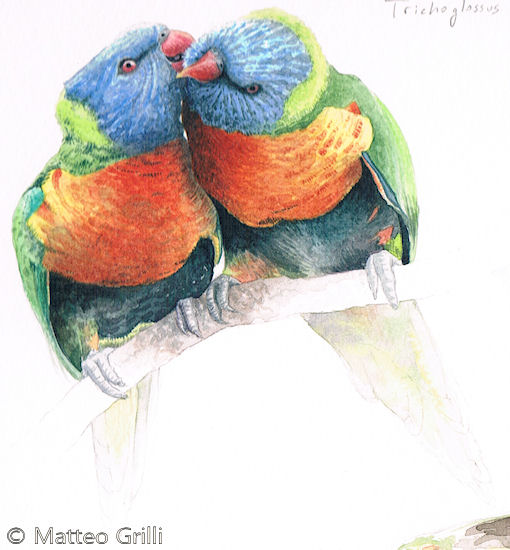
Garden Visitors - the Rainbow Lorikeets


A flock of Rainbow Lorikeets darting and calling each other in the sky. You can't get more Australian than this. I was noticing how nature manages to get some kind of balance, for instance, such a colorful and flamboyant bird is often appreciated for its look but certainly not for its calls, rather harsh and unpleasant for us, even though they sometimes produce some kind of mellow sounding whistles. If we think of all the avian species famous for their songs, they seem to never show a bright colorful plumage, they are in fact rather dull or humble in terms of colours. Feel free to bring some examples if you know otherwise!


As all other parrots they seem to tie very close bonds within the members of a couple.


And yet their colours are not just pretty, they end up being very useful to communicate within the flock and to deceive predators. Predators looking from the sky would find it hard to focus on a single bird looking just as the tree canopy on which it feeds, while other members of the flock will never loose eye contact with one another, thus helping each other as all flock birds do.

Shop update: the opening of my online shop has been delayed for a little bit longer, I was probably too optimistic, I just want to make sure everything is just right, this week I'm going to see some print samples and hopefully by the end of this week or the next at the longest I'll be ready for the opening. Exciting times!

All the best
M

Tuesday, 1 May 2012

Feather, Beetle and Skull: painting blacks without black

From left: feather of a Tawny Frogmouth, Podargus strigoides; Rhinoceros Beetle, Xylotrupes ulysses; skull of a Pied Butcherbird, Cracticus nigrogularis.


This small painting is a technical exploration on how to reach the darkest darks without using any black-containing pigment - no black, neutral tint, Payne's grey, seppia or indigo. A bit daunting considering that neutrals have always been my favourite and most used colours from the beginning. Yet I can now say that chromatic greys offer a neverending, moody, subtle and beautiful alternative to the black pigments. Colours used: Perylene Maroon, Phthalo Green, Prussian Blue, Burnt Umber, Yellow Ochre, Ultramarine Blue, Titanium (opaque) White for the very last few details on the beetle.


Sunday, 15 April 2012

Garden Visitors - the Crested Pigeon

 
Journal #8, page 4, Crested Pigeon, Ocyphaps lophotes
The whole eye appears to be bigger than it really is, thanks to a patch of bare red skin. This gives the bird a cartoon-like look and a range of interesting expressions.

Tertial left wing feather.

Sunday, 1 April 2012

Tides

Low Tide, watercolour on paper, 23x36cm, 2012 © Matteo Grilli

A stretch of coastline relatively untouched, hidden and primeval lies where the only audible sounds are those of the sea, the wind, the elements and the birds. Just like this for millennia, with the only exception for human voices, occasional and far. Now it is high tide, the sandy patch, the rocks and the pools of yesterday are now a vortex of currents, foam and huge pounding waves. Like all places between land and sea, change is here continuous and tangible.


The waves are relentless, despite the submerged cliffs they still are living and moving mountains of water which become a shattering white explosion overcoming everything. One after the other. There is something fascinating about waves, their relative slowness, languor and unpredictability, their motion and tenacity: irrepressible and necessary. The grace, beauty and power of the ocean's nature is accomplishing its task. 


I wonder where all yesterday's creatures are, the sea cucumbers, the shells, dead or alive, the plovers, the oystercatchers, the seagulls and the dolphins. All under cover, but then it is their home, they know its ways. Every now and then some seagull flies along the coastline southwards, just like the terns and a pair of oystercatchers. The noise of the waves is deafening and endless, but it induces a feeling of peace and soundness. Watching and listening to the mighty force of the ocean from a fair distance is both reassuring and comforting. For now the inhabitants of the coast will have to find their daily bread somewhere else, or wait for the tide to recede.
Woody Heads - NSW


Wednesday, 11 January 2012

Silent Encounters - Part 1

Watercolour on paper, 38x30 cm, life-size

It is difficult to spot Tawny Frogmouths. Walking through the park I noticed three Magpies on the ground, all three looking very inquisitive and curious towards another bird right between them. The bird was facing away from me so I could only see its back side, a big round head and a rounded body nearly invisible because of its amazing camouflage. Strange to see one on the ground in the daylight.

On my desk

Although Tawny Frogmouths - Podargus strigoides - are very similar to owls, they are not, they belong to the order of Caprimulgiformes and to the Frogmouth family, Podargidae. They are very skilled night hunters with big eyes and very soft feathers for a perfectly silent flight. The Magpies eventually lost interest and the bird (a female) then flew after a few minutes on a nearby tree where a nearly fully grown young was looking straight at me. On another branch there was what looked like the remains of an old nest, a flimsy pile of thin twigs,  half of it on the ground. I found some feathers.

Work in progress


When painting feathers there is often a feeling of being more a scientist than an artist, or something in between at least, like observing things through a microscope or a magnifying glass. Their feathers are covered with a layer of what appears to be fur, very very soft and this is the reason for their silent flight, just like owls.

Detail

To be continued next week...

Monday, 14 November 2011

Fascinating feathers


From left: Barn Owl, primary; Laughing Kookaburra, primary; Masked Lapwing, tail feather; Figbird, secondary, Laughing Kookaburra, tail feather; Bush-stone Curlew, primary.
Primary feathers: outer feathers of the wing, provide thrust and propel the bird upward and forward;
Secondary feathers: provide lift by creating the airfoil shape of the bird's wing;
Tail feathers: help the bird to brake and steer in flight.
I've been collecting birds' feathers since I was a child, when our neighbours gave us the tail feathers of the Pheasant they killed and cooked. I still think I can give feathers a second chance to be admired, weather they come from a dead bird or are naturally shed when moulting. And I still wonder how far have they travelled, what places and the secret things they lived with their owner.
Here is a selection of artworks on feathers from my shop.


Thursday, 20 October 2011

A very happy birthday!


Last October the 16th was this blog's first birthday, I am amazed by the wonderful community of people it has gathered so far, to all the followers and visitors I would like to say a big big THANK YOU. This painting is a rather old one, dated September 2007, long before I came to Australia, but I consider it kinda Australian as those feathers came from my budgerigars (Melopsittacus undulatus) which are one of the most common pet birds and originally from Australia. In their native country, in the wild, they live a nomadic life following the rain and the abundance that comes with it. To see more about the amazing life of Australian parrots I'll give you this link, it is a beautiful documentary, let me know what you think if you had the chance to watch it: http://www.youtube.com/watch?v=YQb2o0Lzomo
Until next time!

Monday, 10 October 2011

Rainbow Lorikeets

It is no wonder that when the 1500s Portuguese explorers, mapping the coasts of Australia, named it Psittacorum regio, the Latin for 'Land of parrots'. When I first come to Australia I was astonished to see how easily parrots can be seen in great numbers in any environment, city included. In this period of the year, southern hemisphere spring, trees are blooming very generously and lorikeets are very busy taking the best advantage out of this great food opportunity. The Rainbow Lorikeet is probably the most common Lorikeet in Australia, an icon from Darwin to Adelaide. They are also frequent visitors of bird feeders, but they are bold and aggressive to other species chasing every other bird away, this is in fact one of the reasons for the decline of some other bird species where Rainbow Lorikeets are numerous.  Their screeching calls are filling the air, sometimes harsh, sometimes full of joy, to see them darting in the sky is always a pleasure.
For the Italian readers, or anybody who reads Italian, I started writing for a website called 'I love Australia', written and managed by Italians in Australia, a website whose goal is to give information about anything related to this country, from immigration to nature, travel and holiday and more: http://www.iloveaustralia.it/
Until next time!       Matteo

Monday, 12 September 2011

Meeting the Bush Stone-curlew


I saw three Stone Bush-curlews at the Brisbane Botanic Gardens. They are related to waders but they are actually terrestrial and found on any habitat with ground litter, from rain forests to open woodland, their face expression are very interesting and ever changing. As many other Australian animals they were not scared by close observers, probably because they rely on their camouflage and stillness, I was surprised to read that they are nocturnal birds ( no wonder the big eyes) in fact they looked kinda sleepy. After a bit of research I found a few interesting aboriginal stories related to the Bush Stone-curlew, you can read more following this link: http://blogs.crikey.com.au/northern/2010/09/27/bird-of-the-week-the-bush-stone-curlew-as-a-harbinger-of-death-and-more/
-Names- 
English: Bush Stone-curlew
Latin: Burhinus grallarius
Italian: Occhione willaroo
Aboriginal: Willaroo
Ps:  the feathers by the sketch are real, taped on the page. 
There will be more about these birds on this blog in the future...
Until next time!               Matteo

Friday, 15 July 2011

Sulphur-crested Cockatoo

This amazing bird is available in my shop in an array of different artworks
According to the Slater Field Guide to Australian Birds, Australia is home for 54 species of parrots. I was camping for the National Folk Festival in Canberra and early in the morning we were awakened by the loud raucous screeches of a large flock of Sulphur-crested Cockatoos, an Australian icon. In the morning sun I could see their shadows passing over the tent. I was astonished.
I have also found a way to make this blog carbon neutral, I recommend it to all of you who run a blog or website, find out how at http://www.kaufda.de/umwelt/carbon-neutral/how-you-can-join/
Until next time..          Matteo

Friday, 25 March 2011

New generations and feathers


Autumn encounters: new generations, a young Kookaburra, and moulted feathers, one from the Kookaburra's tail. 

Friday, 21 January 2011

Feathers


A few feathers found at Yeronga Park, Brisbane, to start a new journal. Stone Curlew (?), Masked Lapwing, Crested Pigeon and Tawny Frogmouth...

Monday, 20 December 2010

Scaly-breasted Lorikeets


First left: Rainbow Lorikeet, tail feather. Second: Scaly-breasted Lorikeet, tail feather. Third: Rainbow Lorikeet, primary covert.

Sunday, 24 October 2010

Australian miscellanea


This is a small collection of encounters gathered  after a few hours spent in the bush (Toohey Forest).
Related Posts Plugin for WordPress, Blogger...