Showing posts with label Garden Visitors. Show all posts

Wednesday, 15 March 2017

Saturday, 15 November 2014

Christmas Ideas and a New Painting


I developed this watercolour after taking some photos of this immature Australian King-parrot on the front veranda, the patchy red of the head shows that this is a young male, with time the green feathers of its head will change to a bright red. Below is the first sketch I drew on my sketchbook with some colour studies to find the right mixes and colour harmonies.

Immature Australian King-parrot, watercolour on paper, 16.5 x 23.5 cm, © Matteo Grilli 2014


Christmas is getting closer, it's never too early to order a unique and original gift from my online store, with more than 140 items to choose from and an array of original works (worldwide free shipping), greeting cards, bookmarks, reproductions, a children's book, and more, there is something for any taste and budget. If you are overseas or your order is going to be sent outside of Australia, make sure to order before December 4th to allow enough time for your gift to be processed and delivered. If your gift stays in Australia, you should order by December 18th.

And, if one artwork is not enough, why not ordering a copy of my book 'Watercolour Explorations on Australian Wildlife' containing a large collection of artworks completed between 2010 and 2013?

Until next time,

MG

Monday, 15 July 2013

Found a baby Tawny Frogmouth? Here is the best way to help.


In this post I am going to share the account I wrote last year about my experience in reuniting a baby Tawny Frogmouth with its family, hoping it will be helpful for the readers in case they will find themselves in the same situation during the new coming breeding season.

     On October 2012, I noticed a Tawny Frogmouth sitting on a nest located about six or seven meters from the ground in the park in front of my house. Not long after noticing the nest I could see the white dawn of the newly hatched babies. I've been watching the nest every day, enjoying seeing the baby Tawny Frogmouths growing very quickly. By the size of the two chicks it was obvious that one was older than the other.

     On November the 9th I went out at about 5 am and I saw that the nest was empty and one chick was on the ground at the bottom of the tree. The night before I saw parent and chicks in the nest just before sunset, so I presume the eldest chick fledged during the night. At that moment I could not see any other member of the family. The baby didn't show any sign of sickness or visible injury. I decided to put it into a box and went to the local vet who gave me the contact of a local carer and the baby Tawny Frogmouth eventually ended up with Sandra Bayley, the local carer specialised in Tawny Frogmouths.

     On November the 10th I was contacted by Sandra who suggested I tryed to reunite the baby with its parents on the veranda of my house which faces the park where the Tawny Frogmouth family lives. Between my house and the park there is only a street which is usually very quiet. I arranged a basket on the corner of my veranda tied to the railings and at dusk I placed the baby inside the basket. The baby appeared to be very active and started begging for food and moved out from the surrogate nest right onto the railing. My veranda is about three meters high from the ground and surrounded by a big Jacaranda tree. Everything I observed was from the inside of my house, through the closed door and window, I also turned the lights off and closed the curtains watching only through a small opening between the curtains to avoid any stress for the parents.

     I put the chick out at around 6.15 pm. The baby started begging straightaway and within about twenty to thirty minutes one parent arrived and after checking the situation for a few seconds from the branch of the Jacaranda tree just in front of the veranda, flew onto the railing and fed the chick. I believe the parent was the male as there are some differences between the two parents. The one which came is a bit bigger than the other as well as less shy in the presence of humans and grey in colour. The other parent which never came to visit our veranda is a bit smaller, shyer and has a reddish tint on the feathers.

     I was able to observe the parent hunting from the surrounding branches and feeding the chick every ten to twenty minutes. The baby Tawny Frogmouth never stopped begging and the begging increased as it could see the parent flying towards the veranda. I noticed that the parent makes a small marble-sized ball of pre-ingested food with sudden movement of its crop and then passes it into the baby's mouth. Feeding occurred in this manner for a few hours. Around eleven pm there was a break as I could not see the parent for 45/60 minutes. I went to bed just after midnight when I last saw the parent coming to feed the baby.

     The morning after, on November the 11th, I woke up at 4 am and I saw the same parent feeding the chick twice before the daylight started to increase. While the baby was alone a couple of Magpies and Noisy miners came and got very close to the baby and just as I opened the door to put the baby in the box to prevent it from being harassed, the parent (father) flew over and perched on the closest branch to the baby. The parents' beak was wide open and it was clear that it was defending the chick. The other birds eventually flew away and the parent perched on the railing and after a few minutes adult and chick were snuggling side by side. After a few hours for some reason the baby fell just on top of a potted plant located just below the railing, I decided to get the chick and put it back on to the railing, the parent didn't seem to be worried, it just kept staring at me without showing any defensive behaviour.They spent all day on the railing of our veranda, even when myself and housemates had to go out and pass at a distance of 2-3 meters the birds didn't seem to care too much, they just changed their shape into the branch-like position. 

Father and baby Tawny Frogmouth spending a day on the railing of our veranda.
   
     At 6.20 pm of November the 11th the parent left the railing and started hunting and feeding the baby just as the previous night. I watched the parent feeding the chick every 15 to 20 minutes for about three hours. At 4 am on November the 12 the parent came to feed the baby a couple of times within few minutes. The baby was very active and was flapping its wings energetically until it fell from the railing. The parent was not around at that moment so I took the baby in my hands and walked towards the park. I found a low branch and I put the baby onto it, the baby soon started moving upwards on the branch flapping its wings and started begging again. Within a couple of minutes father flew on the tree followed by mother and after a few minutes, by the eldest sibling. The family was now reunited on the same tree where they spent the all day.

The subject of this story is the one on the left, just after reunification with family.
 
     At dusk I witnessed the first flight of the young bird I rescued, it was a very short one, maybe one meter branch to branch. Later at night I was out again to see the birds, I could hear the baby begging for food from a very high tree branch and the parent was hunting around. I was now able to watch very thoroughly the parent (the same that came to our veranda) hunting as he was not scared by me being there and the light of the street was providing me with enough light to see. Still I was not quite sure if the begging chick up in the tree was the one I rescued or the older sibling. I could not see any other young or parent around.

     The morning after on November the 13th, at 4.15 am, I was very surprised to see the young Tawny Frogmouth I rescued already able to fly tree to tree following the parent to get a feed. I was sure it was the bird I rescued because I found the older sibling on another tree not far. Some Noisy Miners and a Grey Butcherbird spotted the fledgling I rescued and started harassing it, the father came to defend it but didn't stay for long, the chick was then left alone being pecked by the angry Butcherbird who repeatedly hit the young Tawny Frogmouth. The father flew on the tree with the older sibling for the day roosting. I couldn't do too much as it was rather high on a branch. The harassing eventually stopped and the fledgling didn't seem to be much bothered. I had the impression that the parent didn't defend the young as much as he did on the veranda probably because he knew the young was now able to fly and could move if it wanted so, but this is just my thought. The mother flew in and perched on a higher branch and started calling the baby who flew up and snuggled by her side.

     At dusk, I could observe the parents waking up and starting the hunting and feeding routine and the babies begging and following the parents from branch to branch or tree to tree. I could observe this activity every day at the same time around 6.15-6.30 pm.

     The park in front of my house seems to be their territory, it is just a few hundred square meters of bush with different-sized trees generally big and high, there is a small creek and grass and a playground for kids. The park is packed with wildlife by day as well as by night.


This is a story of a straight and successful reunification, although not all cases are so straightforward, it is always worth trying reuniting a baby Tawny Frogmouth (or any other wild bird) with its family as its parents will always be the best parents. Human rearing should only be considered if no reunification is possible.
I felt very lucky and privileged to be able to witness such an intimate part of the life of these common but very secretive wild birds right in front of my house.

Fell free to contact me by email matteogrilliart@gmail.com

Here are some tips to help you reunite the baby Tawny Frogmouth with its family:

1. Wait till dusk then take the baby back to the exact place you found it as soon as possible, the parents are probably somewhere close by.
2. Establish if it is safe (no dogs/cats/traffic) to put the bird on a low branch or a post in a sheltered leafy area.
3. At dusk, which is the moment they become active, watch the baby from a distance, it should call out for food and the parents should come and feed it every 15 to 30 minutes for the whole night.
4. If no parent come to feed the baby right away, just leave it out for the night and check if it's with a parent the morning after, if you believe the baby is being left unattended, it needs help, put the baby into a box, contact your local wildlife association, sometimes vets can also be helpful.
5. The best time to check if the family is together is at dusk and before sunrise.

If you found this information useful, I would love to hear your stories, please do not hesitate to contact me, every case is different and sharing information is always important to raise the knowledge. Thank you

Monday, 23 July 2012

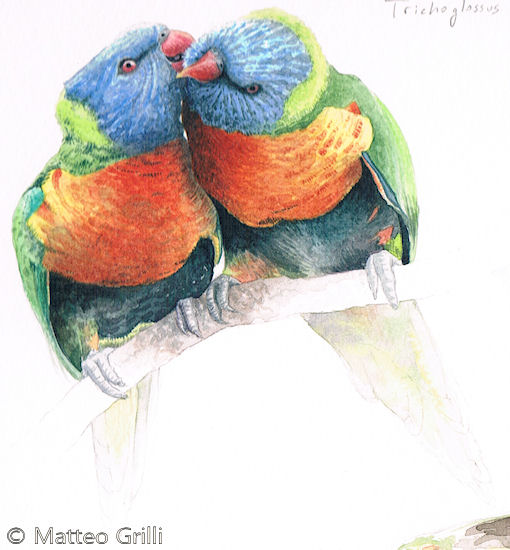
Garden Visitors - the Rainbow Lorikeets


A flock of Rainbow Lorikeets darting and calling each other in the sky. You can't get more Australian than this. I was noticing how nature manages to get some kind of balance, for instance, such a colorful and flamboyant bird is often appreciated for its look but certainly not for its calls, rather harsh and unpleasant for us, even though they sometimes produce some kind of mellow sounding whistles. If we think of all the avian species famous for their songs, they seem to never show a bright colorful plumage, they are in fact rather dull or humble in terms of colours. Feel free to bring some examples if you know otherwise!


As all other parrots they seem to tie very close bonds within the members of a couple.


And yet their colours are not just pretty, they end up being very useful to communicate within the flock and to deceive predators. Predators looking from the sky would find it hard to focus on a single bird looking just as the tree canopy on which it feeds, while other members of the flock will never loose eye contact with one another, thus helping each other as all flock birds do.

Shop update: the opening of my online shop has been delayed for a little bit longer, I was probably too optimistic, I just want to make sure everything is just right, this week I'm going to see some print samples and hopefully by the end of this week or the next at the longest I'll be ready for the opening. Exciting times!

All the best
M

Wednesday, 20 June 2012

Garden Visitors - the Pied Currawong


The Latin name of this bird, Strepera graculina, means 'noisy jackdaw', and the common name Currawong is Aboriginal and is derived from the very musical and loud calls produced by it. Currawongs are the curious and inquisitive 'pirates' of the bush, harassing other species and members of their own group as well, but nature is rather even and the Pied Currawong is the favourite target for the Channel-billed Cuckoo, who, as other cuckoo species parasites other birds' nests.


The Artamidae family, which includes Butcherbirds, Magpies and Currawongs is rather talented, all members are in fact able to produce pleasing if not very nice and elaborate sounds. The Currawong's call is a loud, flute-like sound that echoes far and is a very typical sound of the bush.


Original paintings ready to be packed and delivered.

Business Cards!

Tuesday, 15 May 2012

Shop coming soon...

Garden Visitors: Dainty Swallowtail, Papilio anactus above and Orchard Swallowtail, Papilio aegeus, the latter shows the difference between the male pattern on the left and the female on the right.

I am very glad to inform all the faithful readers and followers that I am working to produce high quality prints of my artwork to sell. I would like to thank all the people who have already contacted me asking for details about their favourite artworks, for their patience and awesome support.

I'd love to keep hearing from you, so if you have any enquiry, even just to let me know about your favourite artwork and your country, please don't hesitate to contact me via email, FaceBook, comments following the posts and subscribe to the newsletter, so that I can keep working on putting things together.

Every artwork on this blog can become a print for you to take home.

Watch this space!

MG


The Caterpillar of an Orchard Swallowtail is a noisy chewer, on the early stages the larva resembles a bird dropping, it later changes into a camouflaged green. Who could ever tell that from a bird-dropping-looking tiny creature an amazing butterfly will later develop?

Sunday, 15 April 2012

Garden Visitors - the Crested Pigeon

 
Journal #8, page 4, Crested Pigeon, Ocyphaps lophotes
The whole eye appears to be bigger than it really is, thanks to a patch of bare red skin. This gives the bird a cartoon-like look and a range of interesting expressions.

Tertial left wing feather.

Thursday, 15 March 2012

Garden Visitors - the Blue-faced Honeyeater

Journal #8, page 3


The colour of the bare skin around the eyes of the adults is a rich and intense mix of shades of blue, a colour that reminds of all the different shades of the colours of the sea on a bright summer day. Beak and tongue are adapted to eat  nectar, pollen, berries and insects.

Juveniles have different colours, starting from an olive-green brown at an early age, the skin then becomes blue in a matter of weeks.
Entomyzon cyanotis in Australia

Friday, 2 March 2012

Avian Faces - Sulphur-crested Cockatoos

Sulphur-crested Cockatoos are full of personality, it doesn't take long to recognize their cognitive skills (likened to those of a four-year-old child) when they observe with an inquisitive look upon what goes on around the feeder. When relaxed, the crest is at rest, and the feathers around the beak all fluffed up, when excited or alerted, the crest is erected and the head is moved with sudden, jerky movements which shows off the bright yellow, curled feathers.


The crest is actually a means of communication. Cockatoos are certainly renowned for imitating human words and this is due to the fact that they are very social creatures, in the wild they have long lasting relationships and to increase their bond the pair develops a 'common language' based on sounds mimicked from each other. As this is not possible in captivity for a single cocky, well, human words or other sounds are used as surrogates.


Their flight in the bright blue sky and the distant (or not so distant) echo of their screeches are a common and typical sight even around the city suburbs and parks. But perhaps, the most beautiful thing is to see them up close, in the late afternoon light which makes everything appear rather magical, with its golden warmth wrapping everything and underlining every movement brought by the wind that moves the branches and the golden-green leaves of the Jacaranda tree. A white cockatoo arriving in flight and landing gracefully on a branch, pervaded by that light is the most majestic of sights.  
-Cacatua galerita-


Monday, 6 February 2012

Garden Visitors - the Noisy Miner


Although this common bird does not have a colourful plumage or a striking beauty, it makes itself noticed by its sounds, high-pitched and harsh whistles which become overwhelming when a whole family is performing together. They are very gregarious birds and almost always seen in flocks, mobbing all other species, they are very determined to chase as far away as possible even the peaceful Crested Pigeons and they chase, mob and fight even the other members of their own species as well.


The Noisy Miner - Manorina melanocephala, is the sentinel of the bush, warning with their loud alarm calls all the members of their flock and other birds about pretty much everything that's going on in the area no matter if it is just a walking person or a snake, in the second case this behaviour could even save their lives. Their way of bathing is rather funny, in fact they fly or jump over the water and plunge noisily into it, flying away soon after plunging splashing water all around, perching nearby and removing excess water with those very fast movement of the wings that all birds do when bathing.


It is probably the most common bird in the Brisbane area and this is due to their aggressiveness which has lead many small species to drastically reduce their populations. Noisy Miners mostly feed on nectar and insects and they benefited from some widespread gardening practices where some plant species are chosen for suburban gardens. They also thrive in cities' suburbs because of their high adaptability regarding feeding, accepting food scraps and leftovers given more or less willingly by humans. All these reasons determined their population to boom in urbanized areas and the decrease of number of smaller species that previously inhabited those territories. 

Wednesday, 4 January 2012

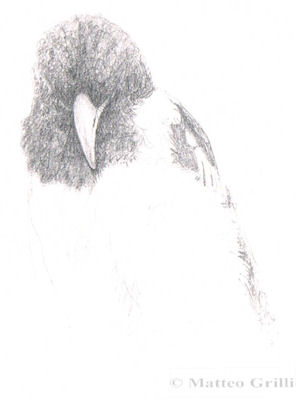
Garden Visitors - the Pied Butcherbird


Every morning at dawn, in that time frame when all birds sing the most, in spring, I could hear this strange flute-like call from the Pied Butcherbird -Cracticus nigrogularis- the tune was perfect in pitch and time and slightly varied at times. It sounded very 'human' in the sense that I thought it was somebody whistling. I recorded it and transcribed it:


This bird may be considered the singer of the bush, with its huge repertoire of calls and songs of its own but also borrowed from other sources. For some reason they are aware that when a human is gardening there might be insects and worms around, so they come and perch very closely to the working gardener and carefully observe the surroundings until an insect runs away from the digging and pruning. The hunter then quickly flies down and grabs its meal.


Their calls and songs are made up of a wide range of mellow, sweet, mysterious and sad whistles and it is one of the most characteristic sound of the bush and suburban gardens. The pair living around our garden regularly comes for drinking and bathing in the bird bath just in front of my studio window. To watch and listen to them is a big pleasure. Once, just during one of its visit, it flew straight from the bird bath to the wall of the building behind it, flying away in less than a second with a gecko in its beak. Very skilled hunter, no wonder we now have a big curious young discovering the world after its parents.

Related Posts Plugin for WordPress, Blogger...